 how-to
Tips for Buying Art Online Safely: 2026 Buyer's Guide
Table of Contents
- Why Buying Art Online Safely Takes More Than a Pretty Listing
- How to Verify Art Authenticity Before You Pay
- Questions to Ask Before Buying Art From Any Seller
- Spotting Scams and Fraud: A Practical Checklist
- Payment Security and Dispute Resolution
- The Complete Landed-Cost Calculator for Online Art
- Art Shipping and Insurance: Protecting Your Purchase in Transit
- Online Art Return Policy: What to Check Before You Click Buy
- What to Do When Your Artwork Arrives Damaged or Not as Described
- Frequently Asked Questions
Last Updated: October 20, 2026
Why Buying Art Online Safely Takes More Than a Pretty Listing
Buying art online safely is a skill, not a gamble. A listing photo can look stunning and still hide a faded print, a forged signature, or a seller who vanishes after payment. This guide from YleaCreations walks you through the exact checks we would run before spending money on any artwork, from authenticity to shipping.
Here is the core problem. Most buyers shop with their eyes. They fall for a bold painting, click buy, and only ask hard questions after the box arrives. That order is backwards. The safest buyers ask questions first and fall in love second.
We built this guide around one throughline: treat every online art purchase like a small due-diligence project. Do the boring checks. Then enjoy the art.
Below, we cover how to verify authenticity, what to ask sellers, how to spot scams, how to pay safely, and how to calculate the real total cost. The 10 sections here form a repeatable workflow you can reuse on every purchase.
How to Verify Art Authenticity Before You Pay
Art authenticity means you can prove an artwork was made by the artist it is credited to. Proof usually comes from three things: a certificate of authenticity, a matching signature, and a documented history of ownership.
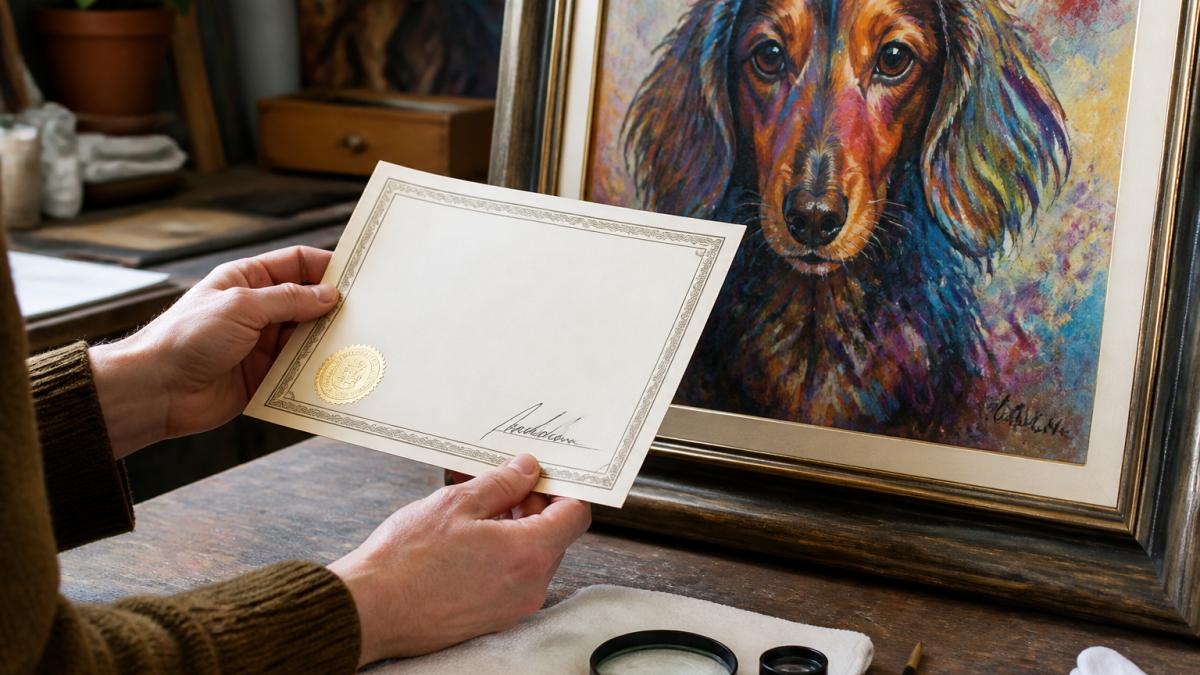
Start with the certificate. A certificate of authenticity (COA) is a document that names the artist, the title, the medium, the dimensions, and the date. It should be signed by the artist, the gallery, or a recognized authenticator. A COA printed on plain paper with no contact details proves nothing.
Next, compare the signature. Ask for a close-up photo of the signature and compare it to known examples of the artist's work. A signature that looks shaky or sits on top of the varnish is a warning sign.
Digital Verification: Certificates, Signatures, and Provenance
Provenance is the documented ownership history of an artwork. It answers a simple question: where has this piece been?
Good provenance looks like a paper trail:
- Gallery receipts or invoices
- Auction records
- Exhibition catalogs
- Previous insurance appraisals
- Photos of the piece in earlier settings
Ask the seller to send this as a digital file before you pay. A serious seller will have it ready. A vague answer like "it's been in the family forever" with no paperwork is a red flag.
Questions to Ask Before Buying Art From Any Seller
Questions to ask before buying art should cover five areas: the artist, the materials, the condition, the paperwork, and the shipping. Ask them in writing so you have a record.
Use this checklist as a message template:
- Who is the artist, and is this an original or a reproduction?
- What are the exact dimensions, including the frame?
- What medium and materials were used?
- Is there a certificate of authenticity, and who signed it?
- What is the condition? Any fading, foxing, tears, or repairs?
- Can you send high-resolution images and detail photographs?
- How will the piece be packed and shipped?
- What is your return policy if it arrives damaged?
A seller who answers all eight clearly is worth your money. One who dodges two or three is not.
Spotting Scams and Fraud: A Practical Checklist
Art scams follow patterns, and the patterns are testable. Instead of memorizing red flags, run every unfamiliar listing through the same five-stage workflow before you send money. Each stage produces evidence you can keep, which matters if you later need to dispute a charge.
Stage 1: Verify the seller's identity
Start with the account, not the artwork. A legitimate seller can be tied to a real business or a real person with a history.
- Search the seller's name and shop name in a search engine and in the platform's own review history.
- Check when the account was created. A shop that opened last month and already has dozens of five-star reviews is a bought profile.
- Look for a physical address, a business registration, or a contact method that is not only an in-platform chat.
- Read the one-star and three-star reviews first. They describe the failure modes that five-star reviews hide.
Stage 2: Test the images
Listing photos are the easiest thing to fake. Test them before you trust them.
- Run a reverse image search on every photo, not just the main one.
- Ask for a detail photo of a specific area, such as the signature, a corner, or the back of the frame, and ask the seller to place a coin or a ruler next to it for scale.
- Compare the requested photo to the listing photo. A seller who cannot produce a new angle of a piece they claim to own does not own it.
- Check image consistency: lighting, background, and frame should match across all photos. Mismatched backgrounds often mean photos were pulled from different sources.
Stage 3: Pressure-test the story
The description is a claim, not a fact. Look for claims that cannot be checked.
- Prices far below market. A signed original priced like a poster is either a reproduction or a fake.
- Copied listing text. Paste a distinctive sentence into a search engine. If it appears on other seller pages, the listing was copied.
- Vague provenance. "It's been in the family forever" with no paperwork is not provenance.
- Pressure to move off-platform. A seller who wants to chat and pay by text or direct transfer is avoiding buyer protection.
- A deposit before viewing. Legitimate sellers do not need a holding fee to show you photos.
- Urgency tactics. "Three other buyers are interested" is a sales script, not a fact you can verify.
Stage 4: Control the payment channel
Payment is where scams become irreversible. Keep the transaction on a channel that can reverse the charge, and refuse any request to switch. Wire transfers, peer-to-peer apps without purchase protection, gift cards, and cryptocurrency are the four methods scammers push because none of them can be clawed back easily. If a seller insists on one of them after you have agreed on a price, treat that as the scam signal and walk away.
Stage 5: Document everything before you pay
Save the listing page, the seller's answers, the detail photos, and the payment receipt in one folder. If the item never arrives or arrives misrepresented, that folder is your dispute file. A common pattern is that buyers who documented the listing win chargebacks and platform disputes far more often than buyers who relied on memory.
Payment Security and Dispute Resolution
Secure payment is your strongest protection, and it costs you nothing extra. Pay with a method that includes buyer protection, such as a credit card or a platform's built-in checkout. Both give you a path to dispute a charge if the artwork never arrives or arrives misrepresented.
Avoid these payment methods for art purchases:
- Wire transfers
- Peer-to-peer payment apps with no purchase protection
- Gift cards
- Cryptocurrency
These methods are hard or impossible to reverse. Scammers push buyers toward them for exactly that reason.
If something goes wrong, act fast. Contact the seller in writing first and keep every message. If that fails, open a dispute with your card issuer or the platform. The Federal Trade Commission's guidance on online shopping and scams explains how to report fraud and what evidence helps your case.
The Complete Landed-Cost Calculator for Online Art
The sticker price is never the real price. Landed cost is the full amount you pay to get the artwork on your wall, and it is the number you should compare across sellers. Build it before you commit.
Use this formula:
Landed cost = artwork price + shipping + insurance + sales tax + customs duties and fees + framing + handling
Work through each line with a specific question, not a guess.
- Artwork price. The listed amount. Ask whether it is final or negotiable, and whether the seller charges a buyer's premium or platform fee on top.
- Shipping. Ask for a written quote to your address, not an estimate. Shipping cost depends on dimensions, weight, fragility, and distance, so a quote for a different buyer tells you nothing.
- Insurance. Ask whether shipping insurance is included and for what declared value. If it is extra, price it separately and confirm the policy covers the full purchase price, not a carrier default cap.
- Sales tax. Online sellers generally collect state sales tax where required. Check the invoice line by line; a seller who offers to skip tax is offering to leave you without a receipt.
- Customs duties and fees. For international orders, the buyer usually pays import duties, taxes, and carrier handling fees on delivery. Ask the seller to state the declared value and the harmonized code they will use, because the duty is calculated from those, not from what you paid.
- Framing. A piece sold unframed may need custom framing before it can hang. Get a framing quote before you buy, especially for non-standard sizes.
- Handling. Crating, double-boxing, and corner protection are sometimes billed separately for large or fragile pieces. Ask whether handling is inside the shipping quote.
Scenario math: three purchases, three landed costs
Run the formula on realistic scenarios so the total stops being abstract.
- A small unframed print shipped domestically. Price, shipping, sales tax, and a modest insurance add-on. Framing is the line that surprises buyers, because a custom frame for a non-standard size can rival the print's price.
- A mid-priced original shipped across state lines. Add full-value shipping insurance and confirm the seller's packing method. Sales tax and shipping dominate; framing may already be included.
- An international purchase of a framed piece. Add customs duties, carrier handling fees, and the risk of a second charge on delivery. The framed piece may also attract higher shipping because of size and fragility, and the declared value drives the duty.
International import mechanics
International orders add steps that domestic buyers never see.
- Customs paperwork. The seller completes a customs declaration stating the contents and value. Ask to see the declared value before shipment; an under-declared package can be held, and an over-declared one costs you more duty.
- Restricted materials. Some materials, such as certain woods, ivory, or shell, face import restrictions. Ask the seller what the piece is made of and whether any component could trigger a hold.
- Transit damage and responsibility. Confirm in writing who files the insurance claim if the piece arrives damaged, and whether the seller or the carrier handles the customs side.
- Delivery timelines. Customs can hold a package for weeks. Build that into your expectations and track the shipment rather than assuming a delivery date.
- Who pays the fees. The buyer usually pays duties and handling on delivery. Budget for it, and ask the carrier whether the fee is collected before or at the door.
| Cost Line | What to Ask | Red Flag |
|---|---|---|
| Artwork price | Is this final, and are there platform fees? | "Price on request" with no range |
| Shipping | Written quote to my address? | Vague "shipping calculated later" |
| Insurance | Included, and at what declared value? | No insurance option at all |
| Sales tax | Will it appear on the invoice? | Seller asks you to skip tax |
| Customs duties and fees | Who pays on delivery, and what is the declared value? | Seller claims "no duties ever" |
| Framing | Framed or unframed, and what size? | Photos hide an unframed edge |
| Handling | Is crating or double-boxing billed separately? | Handling buried in a vague shipping line |
Add the lines together. If the total still feels fair against comparable pieces, buy. If not, negotiate or walk. The point of the calculator is not to talk you out of a purchase; it is to make sure the number you compare is the number you actually pay.
When you are ready to add a piece to your wall, browse the colorful animal art, expressive apparel, and mood-lifting gifts in our store and apply the same landed-cost math to every listing you consider.
Art Shipping and Insurance: Protecting Your Purchase in Transit
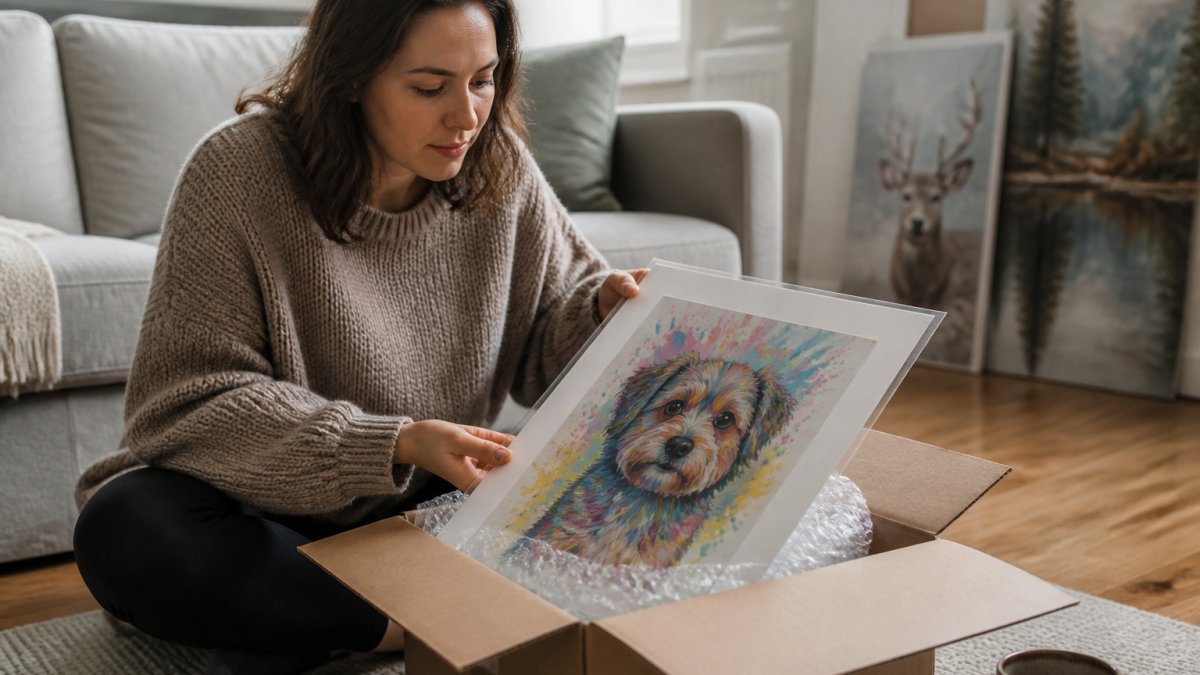
Art shipping and insurance protect the money you just spent. Professional art shipping uses rigid boxes, corner protectors, glassine or foam wrap, and a double-box method for fragile pieces. Ask the seller to describe their packing in detail.
Insurance matters more than most buyers realize. Confirm three things in writing:
- The shipment is insured for the full purchase price
- The seller or carrier will file the claim if damage occurs
- Photos are taken before packing as proof of condition
Ask for tracking information as soon as the piece ships. Track it daily, and be present for delivery if the piece is valuable. Inspect the box before signing. If the box is crushed or wet, photograph it and note the damage with the carrier before opening.
For international orders, ask about customs handling. Packages can sit in customs for weeks, and some carriers charge handling fees on delivery. Budget for it and track the shipment.
Online Art Return Policy: What to Check Before You Click Buy
Online art return policy terms vary widely, and the differences matter. Read the policy before you pay, not after.
Check these points:
- Return window. How many days do you have after delivery?
- Condition rules. Must the piece be in original packaging?
- Return shipping cost. Who pays to send it back?
- Restocking fees. Some sellers charge one. Know the amount.
- Exclusions. Custom or commissioned pieces are often final sale.
- Damage claims. Is damage handled as a return or a separate claim?
Get the policy in writing, even if it is just a screenshot of the listing page. If the seller cannot state a clear policy, that is your answer. Many buyers find that a clear return policy is a better signal of seller quality than any review score.
What to Do When Your Artwork Arrives Damaged or Not as Described
Act within the return window. The clock starts on delivery day, and every step you take should be documented.
Follow this sequence:
- Photograph the box before opening. Show all sides and any crush marks.
- Photograph the packing materials. This proves how the seller packed it.
- Photograph the damage. Get wide shots and close-ups.
- Message the seller the same day. State the problem and attach the photos.
- Request a specific remedy. A replacement, a repair credit, or a full refund.
- Escalate if needed. Open a dispute with the platform or your card issuer.
Keep the original packaging until the issue is resolved. Carriers and insurers often ask for it. Do not ship anything back until the seller confirms the return address and who pays.
If the piece is not as described, such as a print sold as an original or colors that do not match the photos, treat it as a misrepresentation. Document the gap between the listing and the item, then follow the same steps.
Buying art online safely comes down to a habit: check first, pay safely, and document everything. That habit protects your money and makes the artwork you finally hang feel earned.
At YleaCreations, we built our shop around colorful animal art, expressive apparel, and mood-lifting gifts for dog lovers and daydreamers. Every piece in our curated collection is designed to reflect your personality, not a warehouse template. Browse our vibrant art and apparel, find the piece that feels like you, and shop our store on Etsy with confidence.
Frequently Asked Questions
How can you tell if an online art seller is trustworthy?
Check for a clear About page, a real artist bio, and consistent seller reviews across platforms. Look for high-resolution photos of the actual artwork, not stock images. A trustworthy seller will answer questions about materials, dimensions, and provenance without pressure. Avoid sellers who demand payment outside the platform or refuse to share detail shots. For original art, ask for a certificate of authenticity and confirm the return policy before buying.
What should you check before buying art online?
Before buying art online, confirm the artwork's dimensions, medium, and condition. Ask for detail photographs of edges, corners, and any signatures. Verify the seller's reputation through reviews and a return policy. Calculate total landed cost including shipping, insurance, and any applicable sales tax. Use a secure payment method like a credit card. For original artwork, request a certificate of authenticity and provenance details. These steps help you avoid surprises and protect your purchase.
Can you return artwork bought online?
Return policies vary by seller. Before buying, read the online art return policy carefully. Check the return window, who pays return shipping, and whether original artwork is excluded. Some sellers offer a satisfaction guarantee, while others sell final sale. If the artwork arrives damaged or not as described, document the condition with photos immediately and contact the seller. Using a credit card gives you dispute rights if the seller does not honor the policy.
What should you do if art arrives damaged?
If art arrives damaged, photograph the packaging and the artwork before moving it. Keep all original packaging materials. Contact the seller within the return window and provide photos. If the artwork was insured, file a claim with the carrier. Do not discard the damaged item until the claim is resolved. If the seller does not respond, dispute the charge with your credit card company. Prompt documentation is key to a successful resolution.