 how-to
Why Custom Apparel Prices Vary So Much
Last Updated: October 30, 2026
Quick Summary
Custom apparel prices vary because of four main cost drivers: the blank garment, the decoration method, the order quantity, and the add-on fees layered on top. Fabric type, ink colors, print placement, and setup costs all shift the final quote, and shipping, taxes, and rush fees land on top of the advertised price.
- Screen printing carries higher per-color setup costs but is cheaper per unit at high volume.
- Direct-to-garment printing has minimal setup and suits orders of 1 to 50 units.
- Per-unit cost is roughly setup divided by quantity plus variable cost, so doubling quantity halves the setup share.
- Ask for setup as a separate line item so you can compare quotes apples to apples.
- Best value means lowest cost per wear, not the lowest sticker price.
Table of Contents
- The Real Reasons Custom Apparel Prices Vary
- The Custom Apparel Pricing Factors That Move Every Quote
- Screen Printing vs. Direct-to-Garment Printing
- How Custom Apparel Bulk Order Pricing Changes Unit Cost
- Setup Costs, Labor Costs, and the Custom Design Fee
- Shipping, Taxes, Rush Fees, and Other Add-On Charges
- How to Compare Custom Shirt Quality Before You Pay
- How to Get the Best Value on Custom Apparel
- Find Expressive Custom Apparel at YleaCreations
- Frequently Asked Questions
The Real Reasons Custom Apparel Prices Vary
Custom apparel prices vary because of four main cost drivers: the blank garment, the decoration method, the order quantity, and the add-on fees layered on top. According to Printful's T-shirt industry statistics and trends, the global T-shirt market alone is valued at $30.68 billion in 2026 and climbing toward $44.81 billion by 2035. That's a lot of shirts. It's also a lot of price tags, and they rarely match.
At YleaCreations, we hear the same question from shoppers constantly: why does one printed tee cost a few dollars more than another that looks identical in the photo? The answer almost never comes down to the design. It comes down to what's underneath it.
Below, we'll break down every factor that moves a quote, show you how to read a pricing sheet without getting fooled, and explain how to compare custom shirt quality before you pay. Most guides skip the part that actually matters: the itemized math.
The Custom Apparel Pricing Factors That Move Every Quote
A custom apparel quote is a stack of small decisions, and each one adds or subtracts from the final number. The blank garment, the fabric, the ink, the print size, the quantity, and the labor all pull the price in different directions. Change one, and the whole quote shifts.
A 2026 pricing guide from Arklavo's custom T-shirt cost breakdown identifies three core factors: blank garment choice, decoration method, and order volume. That's the skeleton. The muscle is in the details below.
Blank Garments and Fabric Type
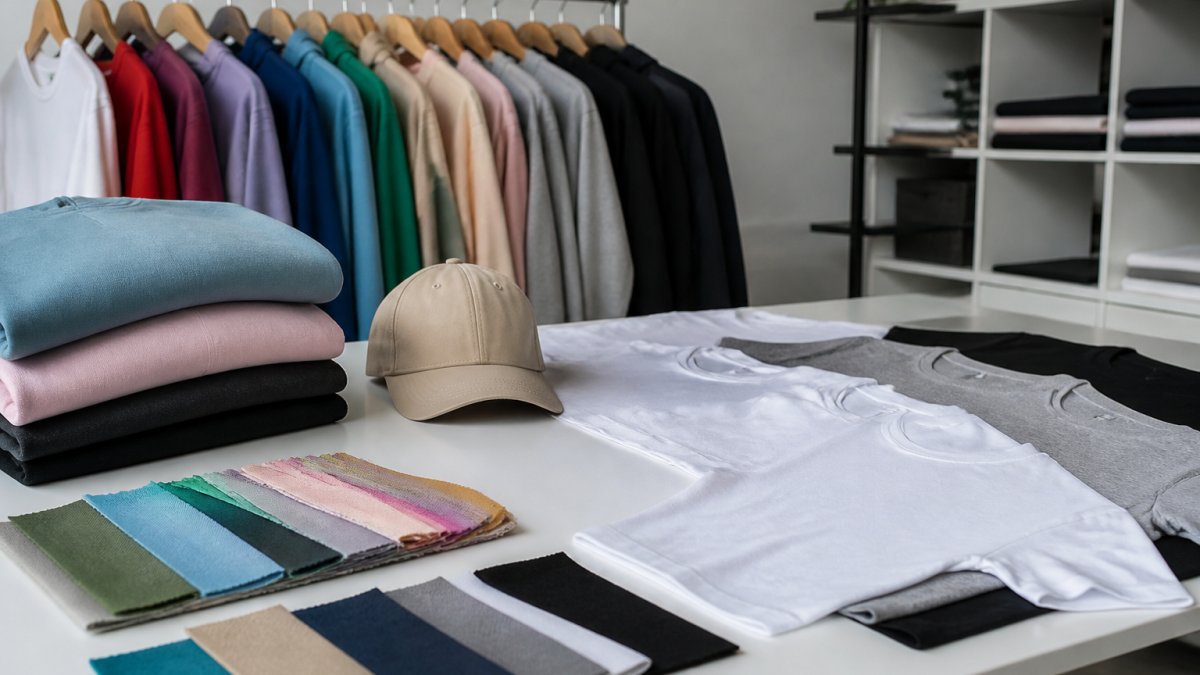
The shirt itself is your biggest single line item, and fabric is where the real spread lives. A basic cotton tee and a heavyweight ring-spun cotton or cotton-poly blend are not the same product, even if they photograph the same.
Here's what drives the garment cost:
- Fiber: 100% cotton costs more than poly blends at the premium end.
- Weight: Heavier fabric uses more raw material.
- Construction: Double-stitched seams and reinforced collars cost more to make.
- Shirt brand: Name-brand blanks carry a premium over house brands.
- Garment color: Some dyes and specialty colors cost more, especially on small runs.
Raw material costs ripple through everything. When cotton prices rise, blank garment prices follow. A printer quoting you a rock-bottom rate is usually quoting a lighter, cheaper blank.
If you want the full breakdown of why a heavier, better-made shirt costs more, our guide on why quality apparel costs more walks through fabric, construction, and labor line by line.
Design Complexity, Ink Colors, and Print Placement
Design complexity is the second-biggest lever, and it's the one most shoppers underestimate. Every additional ink color means another screen, another setup, and another pass through the press. A one-color design and a five-color design can differ by several dollars per shirt on a small order.
The variables that add cost:
- Ink colors: More colors, more screens, higher setup.
- Artwork detail: Fine lines and gradients are harder to print cleanly.
- Print placement: A left-chest logo is cheap; a full back plus sleeve print is not.
- Print size: Bigger prints use more ink and take longer to press.
A Groggy Dog pricing analysis names color count, garment tier, print locations, and extended sizes as the four biggest price drivers. Extended sizes, in particular, catch people off guard. Larger sizes use more fabric and often cost more per unit.
Screen Printing vs. Direct-to-Garment Printing
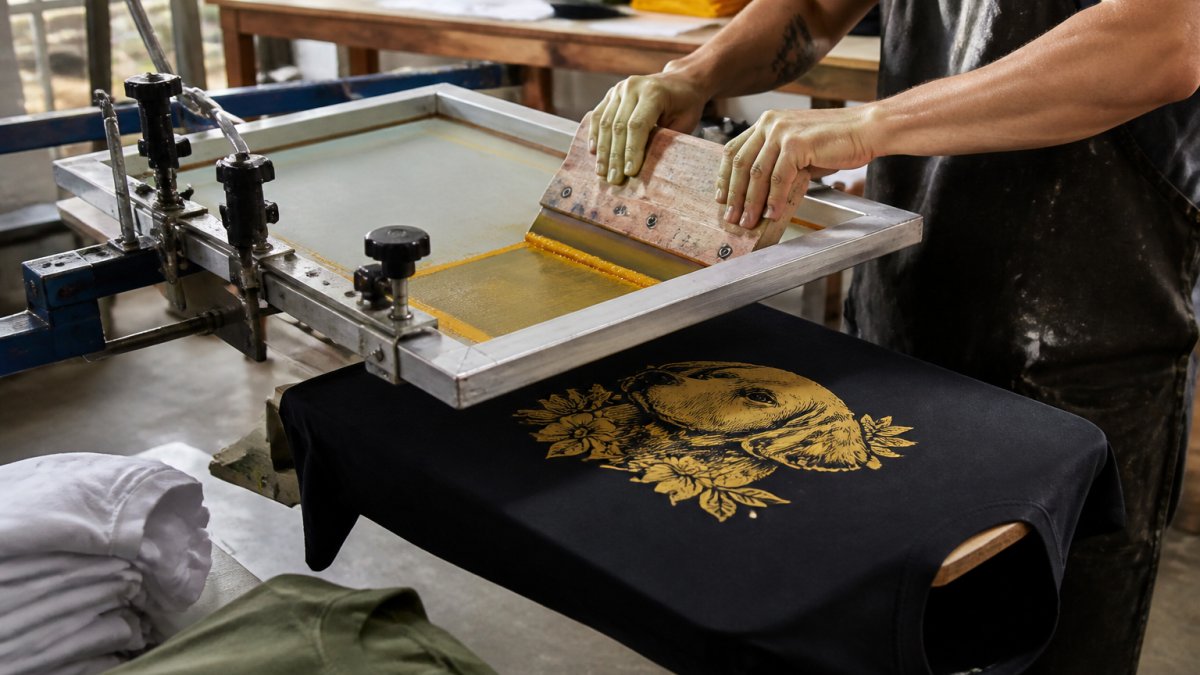
Screen printing and direct-to-garment (DTG) printing are the two most common decoration methods, and they behave very differently on price. Screen printing is cheaper per unit at high volume but carries setup costs. DTG has little to no setup but a higher per-unit cost that doesn't drop as fast with volume.
Here's the side-by-side:
| Factor | Screen Printing | Direct-to-Garment (DTG) |
|---|---|---|
| Setup cost | Higher, per color | Minimal |
| Best order size | 24+ units | 1-50 units |
| Per-unit cost at scale | Drops sharply | Stays relatively flat |
| Color complexity | Costs more per color | No extra cost |
| Durability | Long-lasting on cotton | Good, varies by wash care |
| Best for | Bold, simple designs at volume | Detailed, full-color art |
The short version: if you're ordering 50 shirts with a bold two-color logo, screen printing wins on price. For a closer look at how each method holds up over time, see why custom apparel prints fade fast. If you need 10 shirts with a detailed watercolor design, DTG is the smarter call.
How Custom Apparel Bulk Order Pricing Changes Unit Cost
Bulk order pricing works on a simple principle: higher volume spreads fixed costs across more units, so the per-unit price drops. But the principle alone doesn't help you budget. What matters is knowing which costs are fixed, which are variable, and where the price breaks actually land.
A screen-printing order generally carries fixed setup costs and variable per-unit costs. Fixed costs don't change with quantity, so every additional unit absorbs a smaller share of them. Variable costs stay roughly flat per unit no matter how many you order.
That produces a predictable curve:
- Small runs (1-23 units): Fixed setup is spread across very few units, so per-unit cost is highest. A one-color screen print on 12 shirts can carry a meaningful setup premium per shirt.
- Mid runs (24-99 units): Setup dilutes quickly. This is usually where the steepest per-unit drop happens, because the same fixed cost is now divided across dozens of units.
- Large runs (100+ units): Per-unit cost approaches the variable cost floor. Further discounts are smaller and incremental, and you commit to inventory.
A simple way to see it: if setup is a fixed amount and the per-unit variable cost is steady, the per-unit total is roughly (setup ÷ quantity) + variable cost. Double the quantity and the setup share per unit halves. That's why the jump from 12 to 24 units often saves more per shirt than the jump from 100 to 200.
Decoration method changes the shape of the curve. Screen printing has high fixed setup and low variable cost, so it rewards volume. Direct-to-garment has minimal setup and higher variable cost, so its per-unit price stays relatively flat across quantities. Embroidery sits in between, with digitizing as a one-time setup and stitch count driving per-unit time.
The trap is ordering more than you need just to hit a price break. A slightly higher per-unit cost on 20 shirts beats a lower per-unit cost on 200 shirts you can't sell. Match the order to the actual use case, and ask your printer where their real price breaks fall rather than assuming round numbers like 50 or 100 are the only tiers.
If you're weighing a larger run, our Sweatshirts T Shirts collection shows how garment choice interacts with quantity, since heavier styles and specialty colors can shift the break-even point.
Setup Costs, Labor Costs, and the Custom Design Fee
Setup costs are the one-time charges that cover preparing your design for production. Pricing depends on quantity, design details, and delivery, so request a quote for specifics.
Labor costs generally scale with complexity, and any custom design fee depends on the specifics of your order.
The part most guides skip is how these line items combine into the number you actually pay per item. Here's the structure of a transparent quote:
- Blank garment cost, the per-unit price of the shirt itself, which varies by brand, fabric weight, and color.
- Decoration cost, the per-unit print or embroidery charge, which depends on method, ink colors, print size, and placement.
- Setup fees, one-time charges for screens, digitizing, or file prep, divided across the order quantity.
- Labor and handling, per-unit time for pressing, folding, tagging, and packing.
- Shipping and add-ons, freight, rush fees, and any small-order surcharge.
When you divide the one-time setup fees by the order quantity and add them to the per-unit garment and decoration costs, you get the true per-item price. That's the number to compare across quotes, not the advertised garment price.
A practical quote-comparison checklist helps here. Confirm that each quote uses equivalent garment quality, the same print dimensions, the same number of colors, the same placements, and the same turnaround. A quote that looks cheaper may simply be using a lighter blank or a smaller print.
If you want a garment that already reflects careful material and construction choices, browse our Sweatshirts T Shirts collection to see how quality shows up in the finished piece.
Shipping, Taxes, Rush Fees, and Other Add-On Charges
The number on the product page is rarely the number you pay. Shipping, sales tax, rush fees, and small-order surcharges all land on top of the quoted price.
The add-ons to check for:
- Shipping: Varies by weight, distance, and speed.
- Sales tax: Applied per your state's rules.
- Rush fees: Expedited production usually costs extra.
- Small-order surcharge: Some printers add a fee below a minimum quantity.
- Extended sizes: Often priced higher per unit.
Before you order, check our website for current return information if something arrives wrong.
How to Compare Custom Shirt Quality Before You Pay
Quality comparison comes down to three things you can check before spending a dollar: the print, the fabric, and the construction.
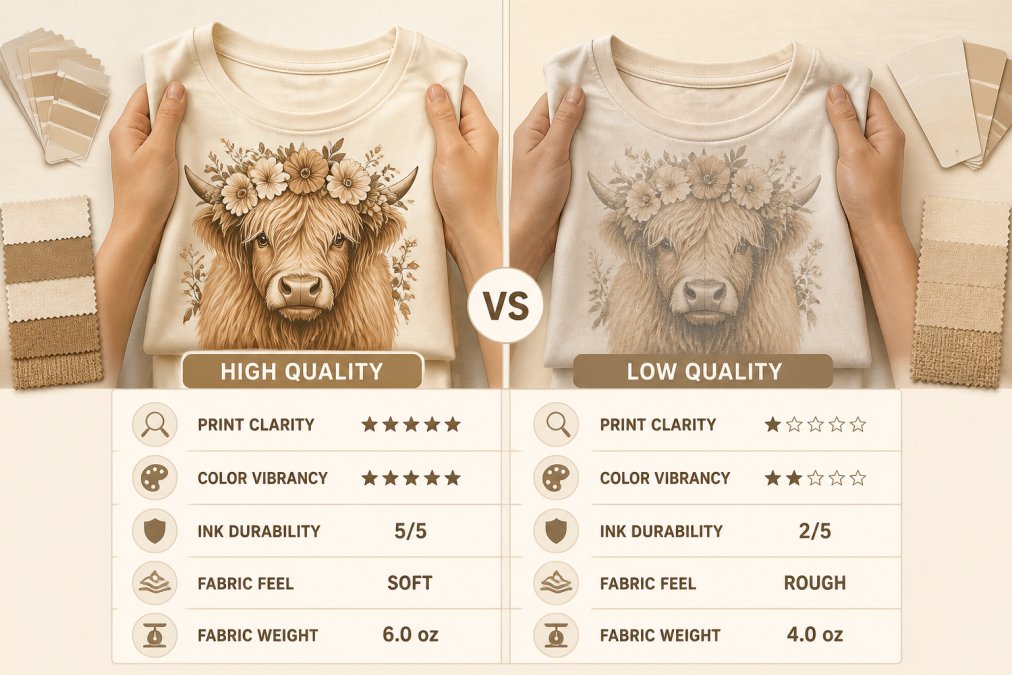
Run this checklist before you commit:
- Ask for the blank garment brand and weight.
- Request a photo of the actual print, not a mockup.
- Check the fabric content and care label.
- Confirm the print method and expected durability.
- Ask about the return policy for defects.
For a deeper look at what separates a clean print from a sloppy one, see our guide on how to spot quality screen printing.
How to Get the Best Value on Custom Apparel
Best value isn't the lowest price. It's the lowest cost per wear, and that math favors a better garment almost every time. BKNY Printing's guide to custom apparel mistakes warns against choosing a shirt purely because it's the cheapest option. A cheap tee that fades in three washes costs more per wear than a quality one that lasts two years.
How to get real value:
- Order the right quantity to hit a price break without overbuying.
- Simplify the design to fewer colors if you're printing at volume.
- Skip rush fees by ordering ahead.
- Compare itemized quotes, not just totals.
- Buy quality once instead of replacing cheap items twice.
A Sustainability study on apparel customization found that shoppers increasingly value authenticity and perceived quality in custom apparel. Price still matters, but it's no longer the only signal.
Find Expressive Custom Apparel at YleaCreations
Here's the challenge: most custom apparel shopping is a race to the bottom on price, and the shirts show it. We'd rather you buy one piece you love than five you tolerate.
At YleaCreations, we offer a curated collection of colorful, expressive apparel and gifts for animal lovers, daydreamers, and anyone who wants their wardrobe to feel like them. Browse our store to find a design that feels like you.
Get started with YleaCreations and find the expressive piece your wardrobe has been missing.
Frequently Asked Questions
Why do custom apparel prices vary so much?
Custom apparel prices vary because several costs stack on top of each other: the blank garment, the fabric type, the decoration method, the number of ink colors, print placement, design complexity, and order quantity. The main drivers are generally blank garment choice, decoration method, and order volume. Two quotes for the same design can differ a lot depending on which garment tier and print method each shop uses.
Does ordering more custom shirts lower the price per shirt?
Often, yes. Custom apparel bulk order pricing usually includes quantity discounts because higher volume reduces the per-item impact of production costs, according to Custom Tees Now. Setup costs like screens and artwork prep get spread across more units, so the per-unit price drops as the order grows. Ask for a quote at two or three quantity tiers so you can see where the price break actually falls.
Is more expensive custom apparel always better quality?
No. A printing-business article from BKNY Printing cautions against choosing a shirt solely on lowest price, but the reverse is also true: a higher price does not guarantee a better garment. Price reflects garment tier, decoration method, and volume, not quality alone. Check fabric weight, stitch quality, and print durability directly, and use the custom apparel pricing factors to judge whether the extra cost buys something you can feel.
How do screen printing and direct-to-garment printing affect price?
Screen printing carries setup costs per ink color but gets cheaper per unit at higher volumes, so it suits larger runs with simple designs. Direct-to-garment printing skips screens and handles detailed, multi-color artwork without setup fees, which can make small or one-off orders more affordable. The right choice depends on your order quantity, color count, and design complexity, so compare both methods on the same quote.