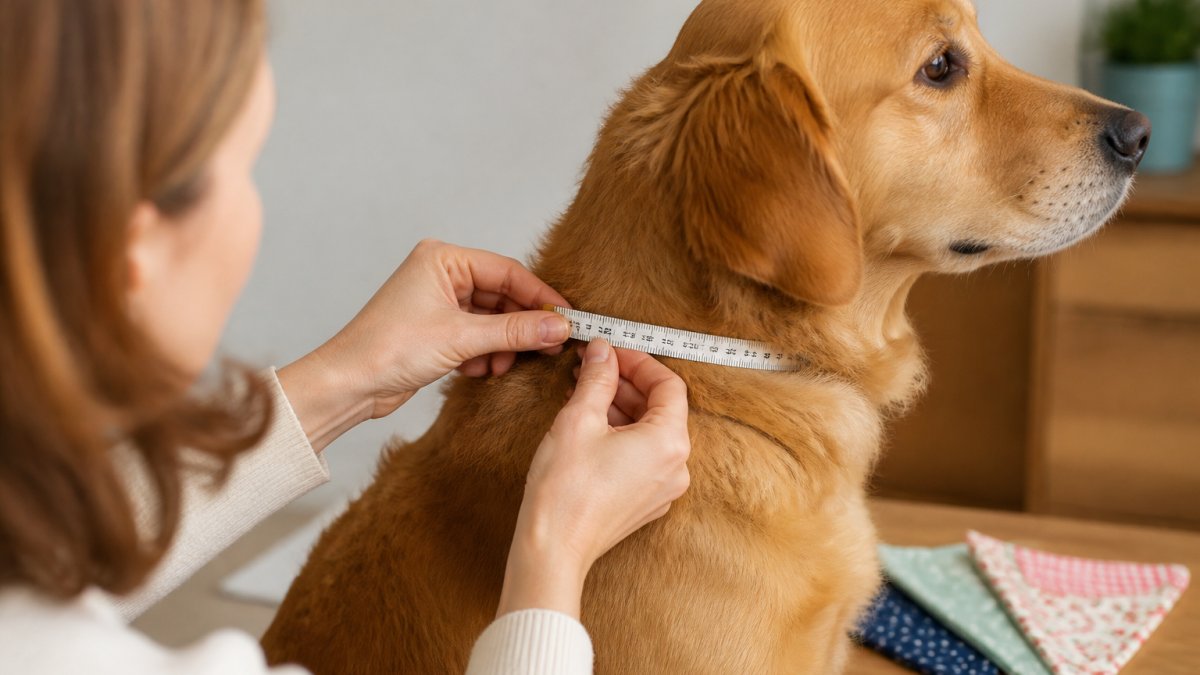
 how-to
How to Measure Dog Neck for Bandanas: Sizing Guide
Table of Contents
- Why an Accurate Dog Neck Measurement Matters
- What You'll Need to Measure Your Dog's Neck
- Step-by-Step: How to Measure Dog Neck for Bandanas
- How Much Ease to Add for Comfort and Movement
- Reading a Dog Bandana Size Chart
- Tie-On Dog Bandana Size: What to Know
- Slip-On Dog Bandana Size: What to Know
- Homemade Dog Bandana Measurements for Sewing
- Special Cases: Puppies, Fluffy Coats, and Unusual Neck Shapes
- Fit and Safety Checks After Putting the Bandana On
- Frequently Asked Questions
Last Updated: October 9, 2026
Why an Accurate Dog Neck Measurement Matters
A bandana that fits right stays on through a tail wag, a walk, and a good roll in the grass. A bandana that fits wrong slides sideways, bunches under the chin, or ends up in the dirt within minutes. Learning how to measure dog neck for bandanas takes about two minutes, and it saves you from the guesswork of ordering, returning, and reordering.
At YleaCreations, we design colorful pet accessories for dog lovers, and the number one question we get is simple: what size do I order? The answer starts with one number, your dog's neck circumference.
Sizing charts vary from maker to maker. A "medium" from one shop can match a "large" from another. That is why your dog's actual neck measurement matters more than the label on the tag.
Signs Your Dog's Bandana Is the Wrong Size
Most sizing problems show up fast. Watch for these clues:
- The bandana spins around the neck or slides to one side
- Your dog paws at it, scratches, or tries to pull it off
- It leaves a visible red mark or crease in the fur
- The fabric bunches up and hides the design
- It slips off during walks or play
If you see any of these, the fit is off, not the bandana. A quick re-measure usually solves it.
What You'll Need to Measure Your Dog's Neck
You need two things and a calm dog. A flexible measuring tape is the easiest tool. If you do not have one, a piece of string and a ruler work just as well.
Gather these before you start:
- A flexible measuring tape, or a length of string plus a ruler
- A few small treats
- A helper, if your dog wiggles a lot
- A notebook or your phone to write down the number
Have your dog stand or sit in a comfortable spot. Treats keep the mood light and the dog still. If your dog hates standing still, measure while they are relaxed on the couch or right after a meal.
Step-by-Step: How to Measure Dog Neck for Bandanas
Here is the short version: wrap the tape around the base of the neck, keep it snug but not tight, and write down the number in inches. The whole process takes about two minutes.
Total time: 2-3 minutes Difficulty: Easy
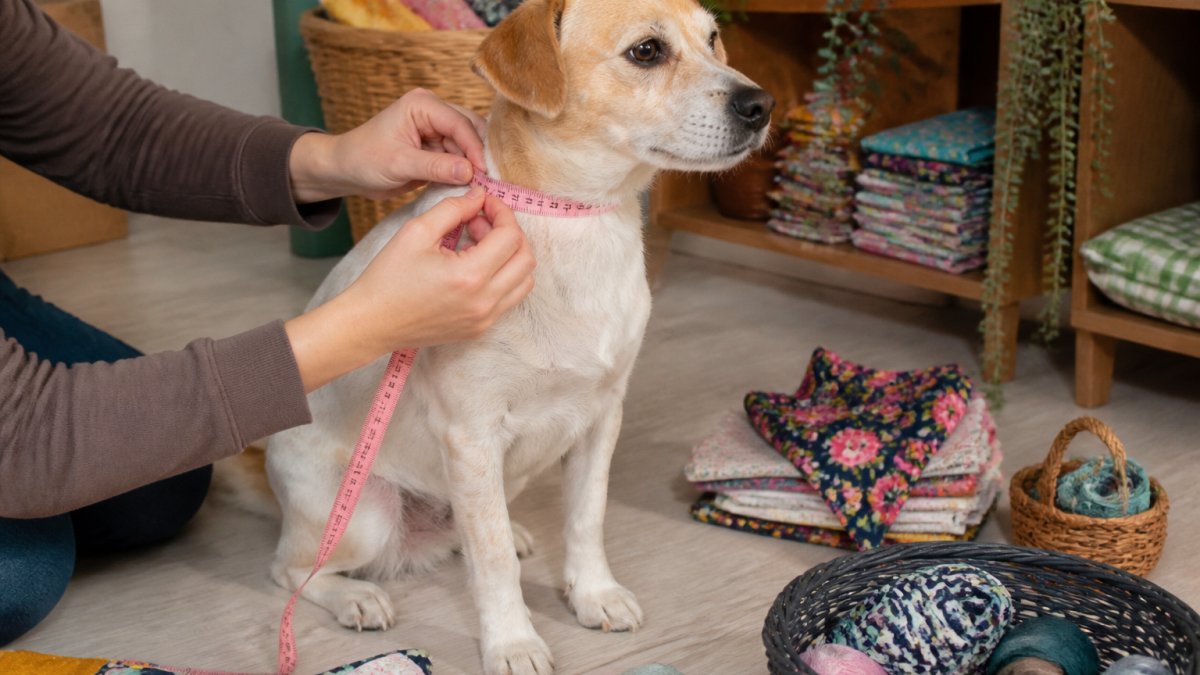
Find the Base of the Neck First
Before you wrap anything, locate the base of the neck. Slide your hand down the back of your dog's head until you feel the shoulder blades. The dip just in front of the shoulder blades is the base of the neck. That is where a collar naturally rests, and it is where a bandana should sit.
If you are unsure, put your dog's everyday collar on and look at where it settles. That spot is your landmark.
The Measurement Walkthrough
- Stand or kneel beside your dog, not in front of them. Facing your dog head-on invites wiggling and eye contact that makes them move.
- Place the zero end of the tape at the base of the neck, right where the collar sits.
- Wrap the tape around the neck, keeping it level. The tape should run parallel to the ground, not angled up toward the ears or down toward the chest.
- Bring the tape around until it meets the zero end. Overlap slightly so you can read the number.
- Slide one finger under the tape. If your finger fits without forcing, the tension is right. If the tape digs in, loosen it. If it slides around freely, tighten it.
- Read the number in inches where the tape meets its start. Round to the nearest quarter inch.
- Write it down immediately. Do not trust your memory, even for a few seconds.
Expected result: A number in inches that matches your dog's neck with one finger of slack.
How to Record the Measurement
Write down three things, not just one:
- The neck measurement in inches
- The date you measured
- Your dog's current weight, if you know it
That last detail matters more than people expect. If you re-measure in a few months and the number changed, the weight tells you whether it is growth, coat change, or something worth a vet visit.
Using a Flexible Measuring Tape
A flexible tape gives you the fastest, most accurate reading. Cloth tapes made for sewing work best because they bend with the neck.
Press the tape flat against the fur. Do not let it twist. If your dog has a thick coat, the tape should sit on top of the fur the way a collar would, not pressed down to the skin.
Using String and a Ruler
No tape? No problem. A piece of string and a ruler get you the same answer.
Wrap the string around the neck at the base. Pinch the spot where the string meets its starting point. Lay the string flat against a ruler and read the length. That length is your dog's neck measurement.
Where to Place the Tape: Base of the Neck vs. Mid-Neck
The base of the neck is the correct spot for bandanas. That is where a collar sits, and it is where a bandana rests most comfortably.
Mid-neck sits higher, closer to the head. Measuring there gives you a smaller number that will not match most size charts. Stick with the base of the neck for the most reliable fit.
Common Measurement Mistakes to Avoid
- Measuring over a thick winter coat and forgetting to add ease for it
- Letting the tape angle up toward the ears, which shrinks the number
- Pulling the tape tight enough to compress the fur, which also shrinks the number
- Measuring right after a bath when the coat is flattened and the number reads smaller than usual
- Measuring a standing, excited dog instead of a calm, settled one
If you catch any of these, re-measure. A quarter inch of error is usually harmless, but half an inch or more can push you into the wrong size bracket.
How Much Ease to Add for Comfort and Movement
Add about one to two inches of ease to your dog's neck measurement, depending on coat thickness and how loose you want the bandana to sit. Ease is the extra room that lets your dog breathe, swallow, and move without the fabric pulling.
Here is a simple rule of thumb:
- Short coat, snug fit: add 1 inch
- Medium coat: add 1 to 1.5 inches
- Thick or fluffy coat: add 2 inches
Too tight is worse than too loose. A bandana that presses into the neck can irritate the skin and make your dog avoid wearing it. A little extra room keeps the bandana comfortable all day.
Reading a Dog Bandana Size Chart
A dog bandana size chart matches neck measurements to size labels like small, medium, and large. Find your dog's measurement on the chart, then pick the size whose range includes that number.
Most charts list a range, such as 10 to 13 inches for a small. Your dog's number should land inside the range, not right at the edge. If it sits on the line between two sizes, read the next section.
Comparing Your Measurement to the Chart
Write your dog's measurement down before you open the chart. Then scan the ranges from top to bottom.
- Find the range that contains your number
- Check whether your number is near the low, middle, or high end
- Note the size label next to that range
If your dog measures 14 inches and a chart lists 12 to 15 inches for medium, medium is your size. If the range reads 13 to 14 inches, you are at the top edge and should size up.
Choosing Between Two Sizes
When your dog's measurement falls between two sizes, size up. A bandana that is slightly loose can be tied or adjusted. One that is too small cannot be fixed.
The exception is a very fluffy dog. Thick coats can make a bandana look smaller than it is, so a size up often looks better anyway.
Tie-On Dog Bandana Size: What to Know
Tie-on bandanas need a little less precision because you control the fit with the knot. The tie-on dog bandana size is usually listed as a range, and you simply tie it tighter or looser to match your dog.
But here is what most guides skip: the size label on a tie-on bandana is not the neck measurement. It is the finished length of the neckband from end to end, including the tie tails. That distinction changes how you read the chart.
How Tie-On Sizing Actually Works
A tie-on bandana has three measurements that matter:
- Neckband length: the total fabric that wraps around the neck plus the tails you tie
- Triangle depth: how far the point hangs down the chest
- Fabric width at the neckband: how tall the band is against the neck
When a shop lists a tie-on as fitting a 14 to 18 inch neck, that range reflects how much neckband fabric is available to wrap and knot. A dog at the low end of the range will have long tails. A dog at the high end will have short tails and a tighter knot.
Reading a Tie-On Size Range
If your dog measures 15 inches and the chart says 14 to 18 inches, you are comfortably inside the range. You will have enough tail to tie a double knot and tuck the ends.
If your dog measures 17.5 inches and the chart says 14 to 18 inches, you are near the top. The bandana will fit, but the tails will be short. Short tails are harder to double-knot and more likely to work loose during play.
A practical rule: aim for the middle of the range, not the edge. Middle-of-range fits give you the most knot flexibility and the longest wear before your dog outgrows the size.
Tie-On vs. Slip-On vs. Over-the-Collar: How Sizing Changes
Each attachment style uses a different part of the measurement:
- Tie-on: sized by neckband length plus tails. Forgiving because the knot absorbs variation.
- Slip-on: sized by the opening diameter. Must clear the widest part of the head, then sit snug on the neck. Unforgiving if your dog's head is much wider than the neck.
- Over-the-collar: sized by the collar width it slides onto, not the neck. If your dog's collar is 1 inch wide, the bandana sleeve must be at least 1 inch. Neck measurement matters only for how the bandana drapes.
This is why a dog can wear a medium tie-on and a large slip-on from the same shop. The size labels are not interchangeable across styles.
When Tie-On Is the Right Choice
Tie-on styles work well for:
- Dogs that are still growing and will need re-measuring every few weeks
- Dogs with thick or seasonally changing coats
- Dogs whose head is wider than their neck, which rules out most slip-ons
- Anyone who wants to adjust fit on the spot without buying a new size
The trade-off is that a tie-on can come loose during rough play. A double knot helps. So does tucking the ends under the knot. Trim tails to no more than a few inches of overhang so there is less fabric to snag.
When you are ready to pick a tie-on that fits right the first time, browse our colorful pet accessories at our Etsy shop. Every piece is made to bring a little more joy and color to life with your dog.
Slip-On Dog Bandana Size: What to Know
Slip-on bandanas slide over the head and stay put without tying. The slip-on dog bandana size must match your dog's neck measurement closely, because there is no knot to adjust.
These styles suit dogs that:
- Sit still for dressing
- Wear a bandana daily
- Do better without dangling fabric
The key number for a slip-on is the opening. It needs to be wide enough to slide over the head but snug enough to stay on the neck. If your dog's head is much wider than the neck, a tie-on is usually the safer pick.
| Style | Fit Adjustability | Best For | Watch Out For |
|---|---|---|---|
| Tie-on | High, adjust with the knot | Growing dogs, thick coats | Can loosen during play |
| Slip-on | Low, fixed opening | Daily wear, calm dogs | Hard to fit narrow heads |
| Over-the-collar | None, slides onto collar | Dogs that wear collars | Needs correct collar width |
Homemade Dog Bandana Measurements for Sewing
Making your own? Start with the neck measurement plus ease, then add seam allowance. Homemade dog bandana measurements follow the same logic as store-bought sizes, just with a few extra steps.
Here is a simple cut guide for a classic triangle bandana:
- Neck measurement: your dog's number plus 1 to 2 inches of ease
- Finished width: the neck number plus about 10 to 12 inches for the tie ends
- Triangle depth: roughly 12 to 15 inches from the neckband to the point
- Seam allowance: add 1/2 inch on each side before you cut
Fold, press, and sew the neckband first. Then attach the triangle and check the fit before you finish the edges. Fabric choice matters too. A soft cotton or flannel sits comfortably, while stiff fabric can rub.
Special Cases: Puppies, Fluffy Coats, and Unusual Neck Shapes
Puppies need re-measuring every few weeks. A bandana that fits at eight weeks may be too tight by twelve. For growing dogs, a tie-on style gives you room to adjust as they fill out.
Fluffy coats change everything. Fur adds visual bulk and can hide the true neck size. Measure over the coat the way a collar sits, and add the full two inches of ease.
Unusual neck shapes, like a very thick neck on a stocky breed or a slender neck on a sighthound, need a closer look at the chart. For thick necks, size up and use a tie-on. For slender necks, a slip-on may slide, so a tie-on with a snug knot holds better.
Fit and Safety Checks After Putting the Bandana On
Run a two-finger test after the bandana is on. You should fit two fingers between the fabric and your dog's neck. If you cannot, it is too tight. If you can fit a whole hand, it is too loose.
Then do a quick safety pass:
- Two fingers slide under the bandana with ease
- The bandana sits at the base of the neck, not up by the ears
- No fur is pinched or twisted under the fabric
- Tie ends are trimmed short or tucked in
- Your dog moves, sits, and shakes without the bandana shifting
- You remove it before crate time or unsupervised play
Watch your dog for the first few minutes. If they scratch at it or freeze in place, the fit needs another look.
A good fit shows off the design and keeps your dog comfortable. When you are ready to find a bandana that fits right and looks like your dog's personality, browse our colorful pet accessories at our Etsy shop. Every piece is made to bring a little more joy and color to life with your dog.
Frequently Asked Questions
How do I measure my dog's neck circumference?
Wrap a flexible measuring tape around the base of your dog's neck, where the collar normally sits. Keep the tape snug but not tight, and make sure it sits flat against the fur without twisting. If you don't have a flexible tape, use a piece of string, mark where it overlaps, then lay the string flat against a ruler to get the number in inches or centimeters. Write the measurement down and compare it with a bandana size chart before ordering.
How much room should I leave between a dog's neck and bandana?
Leave about two fingers' worth of space between the bandana and your dog's neck. That gives enough room for comfort and movement without letting the bandana slip off. For tie-on styles, you can adjust the knot to hit that fit. For slip-on styles, the fabric needs to slide over the head, so the neck measurement should fall within the size range listed on the chart. Always test the fit by sliding two fingers under the bandana.
Can I use a collar measurement to choose a dog bandana size?
You can use your dog's collar size as a starting point, but it is not always exact. A collar sits at the base of the neck and may be tighter or looser than a bandana should be. Measure the neck directly with a flexible tape or string for the most accurate number. If you only have the collar size, add a little room and compare it with the bandana size chart, then double-check with a quick tape measurement before you buy.
How do I measure a dog for a tie-on bandana versus a slip-on bandana?
For a tie-on dog bandana size, measure the base of the neck snugly. The fabric ties and adjusts, so a little extra length is fine. For a slip-on dog bandana size, measure the widest part of the head as well, because the bandana has to slide over it. If the head is wider than the neck, size up so it goes on without pulling. For homemade dog bandana measurements, add a seam allowance and enough fabric for the tie or elastic loop.